
When people think of IVF, the first thing that comes to mind — and the thing they fear most — is “the injections”. The most searched questions are about exactly this: which drugs, how many days, what does it feel like, what are the consequences? This article walks through the ovarian stimulation phase from start to finish, based on the guidelines of the European (ESHRE) and American (ASRM) societies of reproductive medicine. We do not list drug names or doses — they are individual and set by your doctor.
Why is stimulation needed?
In a natural cycle the ovary matures a single egg. For the laboratory to work in IVF, several eggs are needed; stimulation drugs bring a larger share of the follicle group that has already started that month to maturity. (They do not “steal” from future eggs — we explained this in our article on myths.)
How long does it last?
Stimulation usually lasts 8–14 days, on average 10–12. The duration depends on age, ovarian reserve and how the ovaries respond to the drug — which is why the answer to “how many days?” only becomes clear after the first monitoring scan. Some protocols have a preparation period of a few days before stimulation, and egg retrieval and transfer follow it; the whole cycle takes roughly three to four weeks.
Injections: at home, by yourself
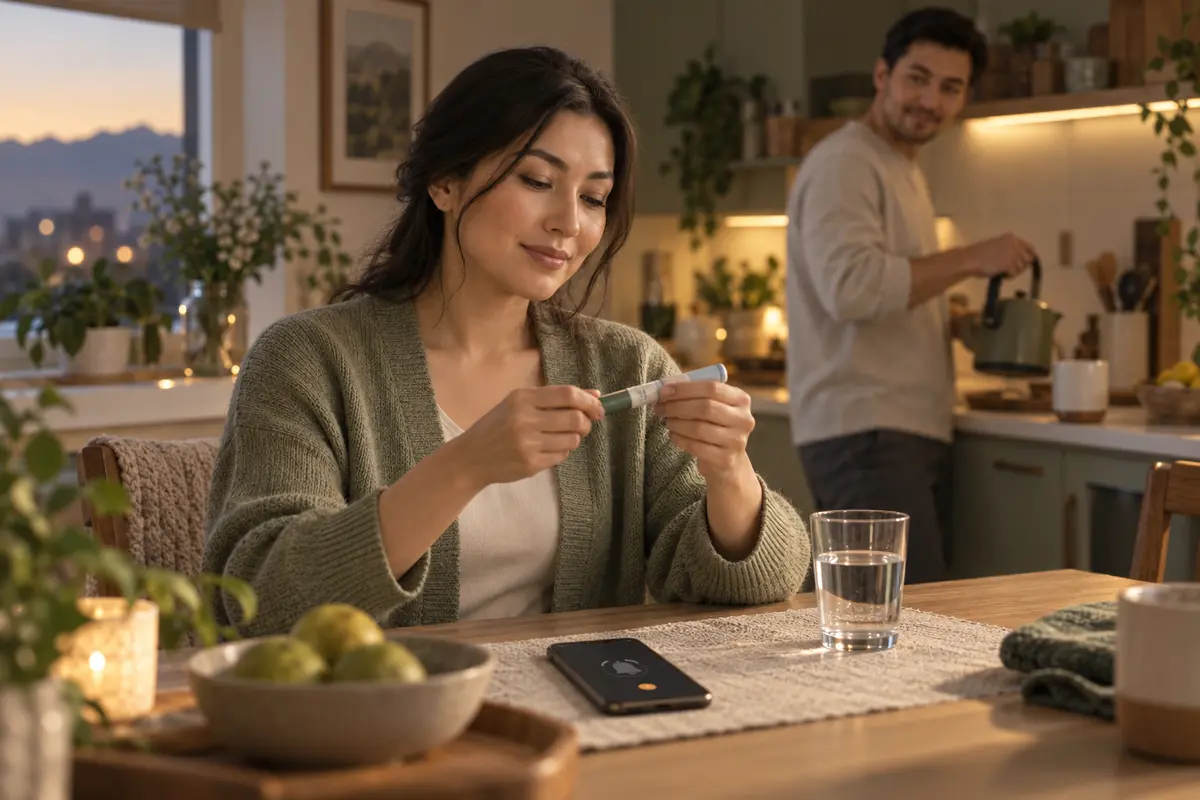
Stimulation drugs are given with fine needles under the skin; most patients do the first one with a nurse and then continue at home themselves (or with their partner). The injections use a pen device with a short needle; patients usually say “it was far easier than I feared”. They are done at the same time every day, usually in the evening. If you are travelling, the drugs may need to be kept cold — ask in advance.
From the middle of stimulation a second drug is added; its job is to stop the eggs from being released too early. At the end of stimulation comes the “trigger” injection: it completes the final maturation of the eggs, and egg retrieval is scheduled exactly 34–36 hours later. The timing of this injection matters to the minute.
Monitoring: how often do I come to the clinic?
During stimulation there are usually 3–4 ultrasound scans; hormone levels are measured by blood test if needed. The scan tracks the number and size of follicles, the dose is adjusted accordingly and the retrieval day is set. Monitoring visits are short and in the morning; there is no need to stop working.
What do you feel?
In the second half of stimulation the ovaries enlarge, so most patients report: fullness and bloating in the lower abdomen, mild cramping, breast tenderness, mood swings, tiredness. These are expected effects and settle within a few days after retrieval. The 1–2 kg on the scales is mostly fluid retention and does not stay. Small bruises at injection sites are possible.
Walking and light activity are good in this period; jumping, running and heavy sport are not recommended — twisting of an enlarged ovary (torsion) is rare but serious. Drink plenty of water; less salt means less bloating.
Why is stimulation different with PCOS?
In polycystic ovary syndrome the ovaries can respond very strongly to the drug; this both raises the risk of over-stimulation and makes dosing delicate. The ESHRE guideline recommends lower starting doses and protocols that reduce the risk of over-stimulation in these patients; if necessary all embryos are frozen and the transfer is postponed to a later cycle. So with PCOS, stimulation is not “harder” but “more careful”.
Stimulation with low reserve
If ovarian reserve is low, a higher dose does not always mean more eggs; the ESHRE guideline notes that going above a certain dose brings no additional benefit. In these patients the doctor sets realistic expectations from the start: the aim is a small number of mature eggs.
The risks: what is OHSS and how do you recognise it?
Ovarian hyperstimulation syndrome (OHSS) occurs when the ovaries respond more strongly to the drug than expected; according to ASRM the mild form is relatively common and the severe form rare. Modern protocols, trigger options and the “freeze all embryos” strategy have greatly reduced severe OHSS. Still, you should know the warning signs:
- Rapidly increasing abdominal bloating and pain
- Nausea, vomiting
- Rapid weight gain over a few days
- A marked decrease in urine output
- Shortness of breath
If you notice any of these, do not wait — call the clinic. OHSS usually begins in the days after egg retrieval; if pregnancy occurs, it can last longer.
The three most common mistakes during stimulation
- Shifting the injection time — especially the trigger. Set an alarm.
- Hiding symptoms — not mentioning bloating “so as not to bother anyone”. Hearing this is the team’s job.
- Comparing doses on forums — another patient’s dose is no measure for yours.
What happens next?
Egg retrieval takes place 34–36 hours after the trigger injection (under brief sedation), the laboratory starts fertilisation the same day, and 3–5 days later the decision on transfer or freezing is made. We described the two weeks after transfer in a separate article. A note on cost: medication is the most variable item in an IVF budget — we explained why on our pricing page.
This article is general information, not a diagnosis or treatment recommendation. Decisions on drugs, doses and protocol belong to your doctor alone.
Sources
- ESHRE guideline — Ovarian stimulation for IVF/ICSI (2020)
- ASRM — Ovarian hyperstimulation syndrome (OHSS)
- ASRM — In vitro fertilization (IVF): what are the risks?
- HFEA (UK) — In vitro fertilisation (IVF)
Still have questions? Leave your number and we will call you
Your details are used only to contact you.