
Timing and clinic visits
ICSI is performed during the laboratory stage of an IVF cycle; it does not lengthen the cycle.
Injection of a single sperm into an egg when medically indicated.
Request a consultation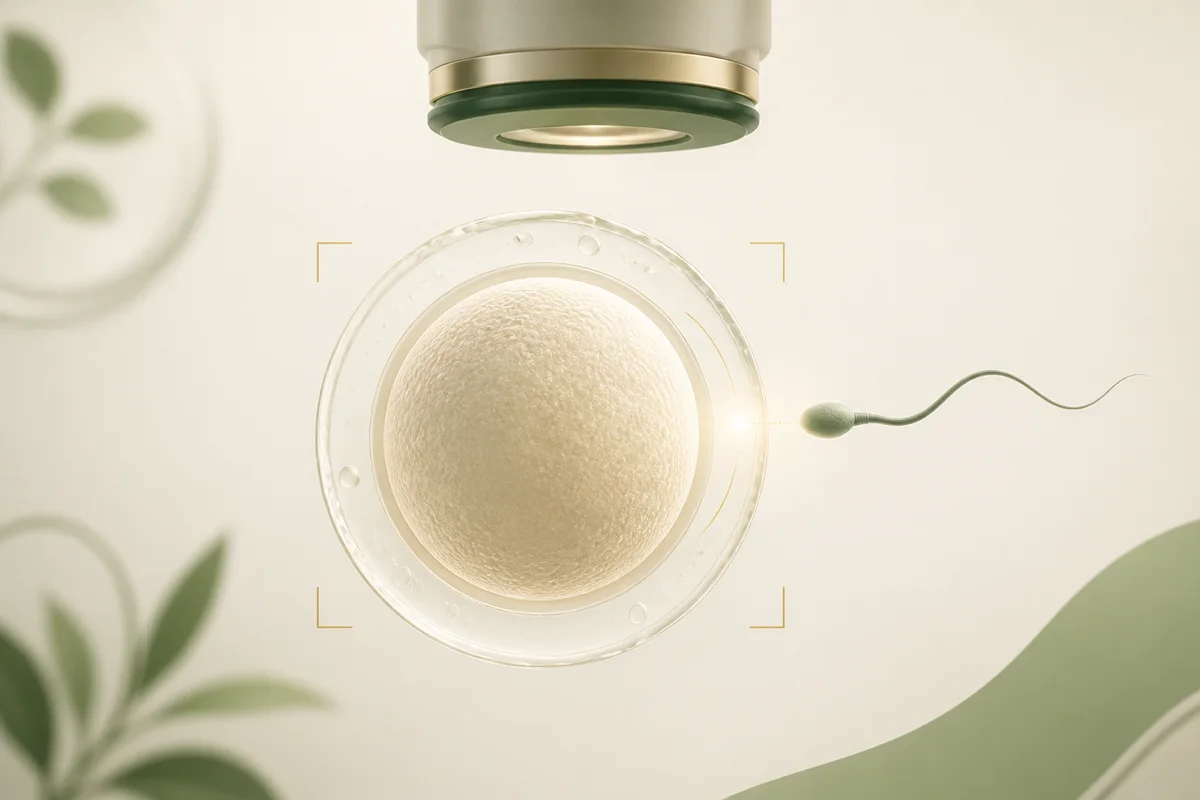
Your details are used only to contact you.
On this page
ICSI is performed during the laboratory stage of an IVF cycle; it does not lengthen the cycle.
Every medical procedure has possible risks and limitations. Personal risks and alternatives should be discussed before consent.
The semen analysis and the investigations on the female side are reviewed together. The possibility of ICSI is discussed at this stage.
Identical to an IVF cycle: a medication period usually lasting 8–12 days with ultrasound monitoring.
Eggs are collected under short sedation and a sperm sample is prepared the same day. Surgically retrieved sperm is used where necessary.
A single sperm is injected into each mature egg under a microscope, in the embryology laboratory.
Fertilisation is assessed the following day and the embryos are monitored for several days; the transfer day is set accordingly.
A suitable embryo is placed in the uterus. The result is assessed by a blood test around two weeks later.

The difference lies only in the fertilisation step. In the conventional method sperm and eggs are placed together; with ICSI a single sperm is injected directly into the egg. All other stages are the same.
No. It is used when there is a medical reason. Choosing it routinely where it is not needed offers no additional benefit.
No. ICSI is a step performed in the laboratory; from your point of view the schedule is the same as an IVF cycle.
Where no sperm cells are found in the sample, surgical sperm retrieval may be considered. If this is a possibility it is planned in advance.
ICSI adds a laboratory procedure to the risks already carried by an IVF cycle. The risks in your particular situation are discussed in detail with your doctor at the first consultation.
ICSI (intracytoplasmic sperm injection) is the injection of a single sperm cell directly into an egg using a fine needle. In conventional IVF, sperm and eggs are placed together and fertilisation is left to happen on its own; with ICSI that step is carried out directly in the laboratory.
ICSI is not a separate treatment but a fertilisation method used within an IVF cycle. Ovarian stimulation, egg collection and embryo transfer proceed in the same way; the only difference is the fertilisation step in the laboratory.
The most common reason is a male-factor finding: a low sperm count, reduced movement, or markedly affected sperm shape. It is also considered when fertilisation was lower than expected in a previous IVF attempt.
Whether ICSI is used is decided together by the embryology team and your doctor after the eggs collected and the sperm sample have been assessed on the day of egg collection. For that reason the plan is sometimes finalised on the day itself.
ICSI helps overcome an obstacle at the fertilisation step; it does not guarantee embryo development or pregnancy. Whether the method is appropriate is assessed separately for each couple.
This page is for general information and does not replace an examination, a diagnosis or personal medical advice.



Your details are used only to contact you.
Leave your name and phone number — we will call you back.