

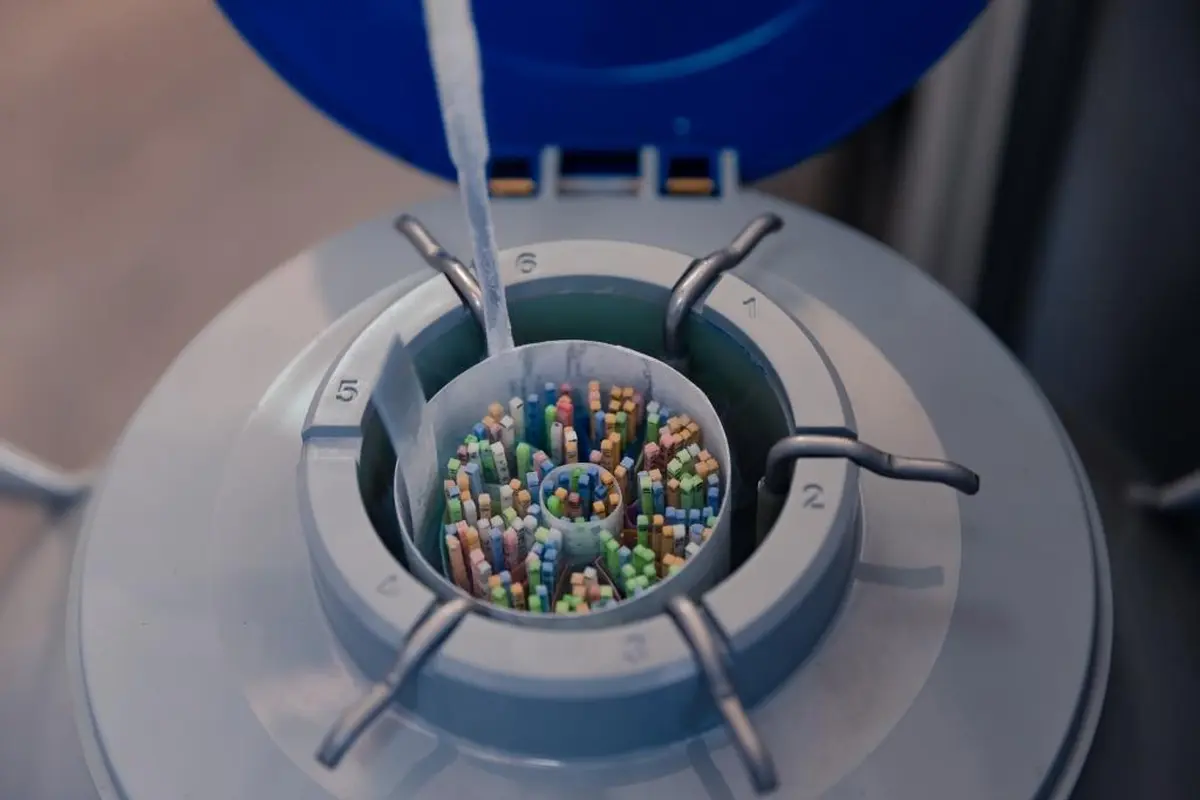
If you have frozen embryos left after an IVF cycle, your next attempt will be much less demanding: there is no ovarian stimulation and no egg collection — the uterus is prepared, and an embryo is thawed and transferred. This is called a frozen embryo transfer, or FET. Below we explain why embryos are frozen, how long they can be stored, what happens on transfer day and what to expect afterwards.
Why are embryos frozen?
- Extra good-quality embryos. Current guidance is to transfer one embryo at a time; the other good embryos are kept for a later attempt or a future sibling.
- A fresh transfer is risky or not ideal. For example, when the risk of ovarian hyperstimulation syndrome (OHSS) is high, the lining of the uterus is not ready, or the woman's health means the transfer should wait.
- Waiting for genetic test results. When PGT is done, embryos stay frozen until the results arrive.
- Preserving fertility. Before chemotherapy or other treatment that may cause infertility. For women without a partner, egg freezing is also an option.
Sometimes all the embryos are deliberately frozen and the transfer is postponed to a later cycle (a "freeze-all" approach). According to the UK regulator HFEA, this is proven to reduce the risk of OHSS, but whether it improves the chance of a baby for all patients is not clear — the evidence is conflicting. So the decision is made case by case.
Vitrification: how an embryo is frozen
The embryo is first placed in a special protective solution — a cryoprotectant — which draws water out of the cells. It is then frozen extremely fast, almost instantly. This is called vitrification: because it is so fast, damaging ice crystals do not form inside the cells. The older slow-freezing method has largely been replaced by vitrification. Frozen embryos are stored in liquid nitrogen tanks at −196 °C. Embryos can be frozen at different stages — for example on day 3 or at the blastocyst stage on days 5–6; the embryologist and doctor decide this.
How long can embryos be stored?
In liquid nitrogen an embryo's biological state barely changes over time, so storage time is set less by biology and more by the law and your consent. The permitted period and how consent is renewed differ from country to country. Before freezing, you sign a written consent form with the clinic that states the storage period, how it can be extended and how the embryos may be used in future. Read this document carefully and ask your doctor about anything that is unclear. If your contact details change, tell the clinic — they will need to reach you when it is time to renew your consent.
Thawing: will the embryo survive?
On transfer day the embryologist thaws the embryo and assesses it. After vitrification most embryos survive thawing well, but not all: sometimes an embryo does not survive, and occasionally none of the thawed embryos is suitable for transfer. An embryo may lose a cell or two but often recovers and keeps developing. The procedure only goes ahead once the embryologist confirms the embryo is suitable — so keep your phone with you that day.
Preparing the uterus: natural or medicated cycle
The embryo needs to be transferred on a day when the lining of the uterus — the endometrium — is ready to receive it. There are two main ways to do this:
- Natural cycle. If your periods are regular, the transfer can be timed to your own ovulation. The follicle, ovulation and lining are tracked with ultrasound and blood or urine tests. There is little or no medication; your doctor may add supportive medicine if needed.
- Medicated (hormone-prepared) cycle. If your periods are irregular or absent, or the transfer date needs precise planning, the lining is first built up with oestrogen, then progesterone is added; the transfer day is timed from the day you start progesterone. Sometimes your own cycle is temporarily suppressed first.
Depending on the protocol, preparing the lining usually takes 2–3 weeks. Your doctor chooses the approach based on your cycle, previous experience and test results.
What happens on transfer day?
The procedure itself is short — usually 5–10 minutes. Your doctor will tell you in advance how to prepare (for example, whether you need a full bladder for the ultrasound). The embryologist confirms the embryo's condition, and the doctor, guided by ultrasound, passes a thin, soft catheter through the cervix and places the embryo into the uterine cavity. For most women it feels like a gynaecological exam, is usually painless and needs no anaesthetic. After a short rest you go home; there is no need for long bed rest.
How many embryos should be transferred?
Many couples think, "If we put back two, our chances double." That is not how it works. Transferring more than one embryo mainly increases the risk of a multiple pregnancy — which means a higher risk of premature birth, low birth weight and complications for the mother. That is why the 2024 guideline of the European Society of Human Reproduction and Embryology (ESHRE) recommends single embryo transfer as the standard, even when several embryos are available. The American Society for Reproductive Medicine (ASRM) also notes that transferring embryos one at a time in later frozen transfers can achieve pregnancy rates comparable to transferring several at once, without the added risk of twins. That is the real advantage of having frozen embryos.
After the transfer
After the transfer, progesterone (and oestrogen in a medicated cycle) continues to support the lining. Your doctor decides how long you take it: until the pregnancy test, and if the test is positive, often into the first weeks of pregnancy. Do not stop your medication on your own — your doctor will tell you when to stop. About 10–14 days after the transfer, on the day your doctor sets, you have a blood beta-hCG test; if it is positive, an ultrasound later confirms the pregnancy. Light spotting can happen in the first days; if you have heavy bleeding or severe pain, contact your doctor straight away. For what you may feel during these days, see our article after embryo transfer, day by day.
What affects the outcome?
- The woman's age when the embryo was frozen — one of the most important factors.
- Embryo quality and stage of development.
- The state of the endometrium and how the uterus was prepared.
- The cause of infertility and general health.
- Laboratory method — vitrification has improved embryo survival after thawing.
According to HFEA, success rates with frozen embryos have been rising year on year, and frozen embryos are considered as safe as fresh ones; the main risk is a multiple birth, which single embryo transfer reduces. Your doctor will explain your realistic chances based on your age and embryo quality. If you have frozen embryos and want to plan a transfer, book an appointment at Ankalife IVF Centre to make a plan with a doctor. More: our embryo freezing and IVF pages.
Frequently asked questions
Does freezing harm the embryo?
Vitrification preserves most embryos well, but some may not survive thawing. For embryos that do survive, HFEA considers frozen embryos as safe as fresh ones.
Is a frozen embryo transfer painful?
Usually not: it feels like a gynaecological exam and is normally done without anaesthetic.
Is a fresh or a frozen embryo better?
It depends. Some studies show an advantage for frozen transfer, others find no difference; when OHSS risk is high, freezing is safer. Your doctor will advise based on your cycle.
Can I go back to my normal routine after the transfer?
In general you can carry on with light everyday activities. If you need any specific restrictions, your doctor will tell you.
How long can embryos be stored?
Biologically, for a long time. The permitted period depends on the laws of the country and the consent you sign.
This article is general information, not a diagnosis or treatment recommendation. Decisions about medication, transfer day and the number of embryos are made only by your doctor.
Sources
- HFEA (UK) — Embryo freezing
- HFEA (UK) — Elective freeze-all cycles
- ESHRE — Guideline: number of embryos to transfer during IVF/ICSI (2024)
- ASRM (ReproductiveFacts) — Elective single-embryo transfer (eSET)
Still have questions? Leave your number and we will call you
Your details are used only to contact you.